Room-Level Detail, Sizing Logic, and Selection Strategy
Pre-launch floor-plan evaluation should always move beyond headline area numbers. What buyers should evaluate is usable geometry: where structural columns sit, how efficiently circulation connects private and social spaces, whether balconies are actually usable, and whether utility/service spaces are realistically planned for daily routines. In larger homes, circulation inefficiency can quietly reduce usable value even when super built-up area appears attractive.
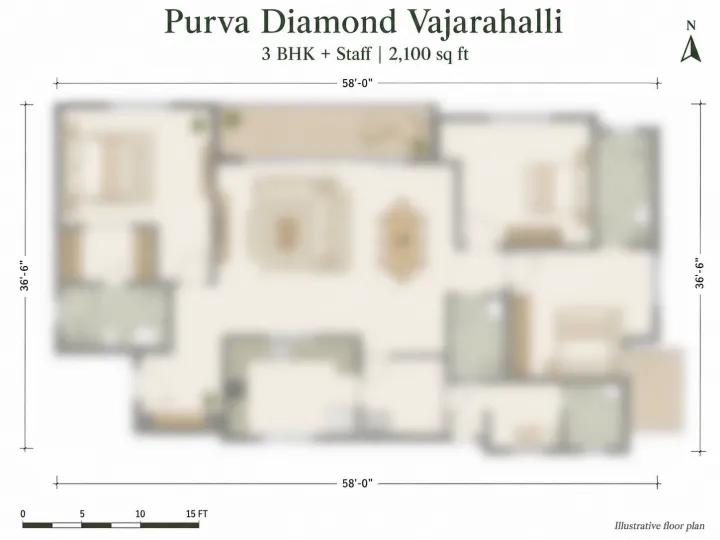
Current project references indicate detailed room dimension snapshots for key layouts, including larger social spaces and dedicated service provisions in the upper variants. The 3 BHK + Staff configuration in particular adds a dedicated utility-cum-staff room, useful for families that retain domestic help or need a flexible work-from-home overflow zone. For buyers choosing between 3 BHK and 3 BHK + Staff, the deciding factor is typically frequency of simultaneous use and household composition.
A practical selection method:
- Choose 3 BHK if your household is compact, you want lower total acquisition burden, and staff utility can be managed externally.
- Choose 3 BHK + Staff if you need service flexibility and occasional multi-family stays without moving to top ticket size.
- Choose 3 BHK + Staff if you retain live-in help, run a work-from-home setup that needs a separate room, or expect multi-generational stays.
Before finalizing, request the latest stamped floor-plan set, carpet area statement, and a full cost sheet aligned to your shortlisted stack and facing. That single step prevents most post-booking confusion around expectations, dimensions, and payment staging.
It is also useful to test your shortlisted plan against real furniture and usage scenarios. Mark dining size requirement, work-from-home desk zones, kids’ study flexibility, and wardrobe depth assumptions before booking. This sounds basic, but it helps avoid post-possession layout dissatisfaction in premium homes where interior decisions are high-impact and expensive to reverse.
For buyers comparing Purva Hallmark with peer projects, keep one consistent worksheet across all options: carpet efficiency (when available), balcony usability, kitchen utility practicality, service zone clarity, and circulation wastage. The project that scores best on these fundamentals usually delivers higher lived value than one that only looks better in marketing visuals.
Four-Units-Per-Floor Stacking - What It Means in Daily Life
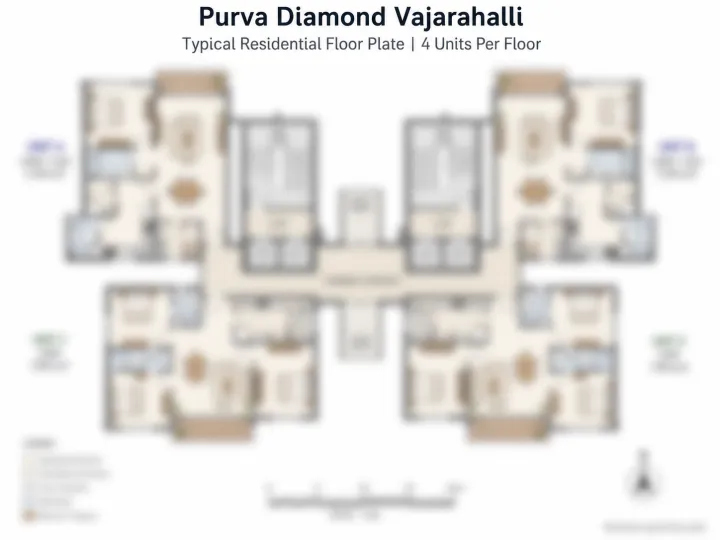
The 4-units-per-floor stacking discipline at Purva Hallmark is one of the most consequential decisions on the entire floor-plan sheet, and it is often under-explained at sales meetings. Distributed across two lift cores per tower, the arrangement places just two residences on each core - which means every home shares its lift lobby with a single neighbour rather than the four-to-six neighbours typical of denser premium towers in the corridor. The privacy implication is immediate: corridor traffic outside your front door is structurally limited, and lift waits during the morning and evening peak compress from the often-quoted three-to-five minutes in dense towers to under a minute in projects with this stacking ratio. With approximately ~250 residences spread across two 33-floor towers, the lift-to-resident ratio at Purva Hallmark is genuinely favourable for daily living rather than a marketing line.
There is a second-order privacy benefit that buyers often discover only after possession: the smaller the floor-plate, the easier it is to maintain meaningful separation between facing units, eliminate awkward overlooking conditions across the corridor, and protect each residence’s entry from being a thoroughfare. Service movement - housekeeping, deliveries, maintenance - also becomes less visible to residents because the daily volume per floor is genuinely lower. These are the kind of details that do not photograph well in a brochure but show up clearly in the lived experience over a five-to-ten-year ownership horizon.
Choosing Between 3 BHK and 3 BHK + Staff - Who Each Format Fits
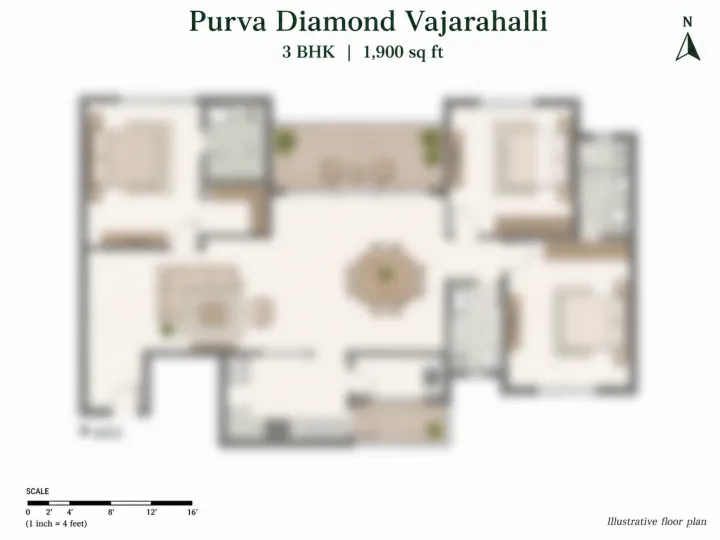
The 3 BHK at ~1,900 sq ft is the right format for buyers whose household composition is compact - typically a couple with one or two children, or a family without live-in domestic help. The all-in cost sits in the ₹3.10–3.25 Cr band, which is the lower end of the project’s ticket spectrum. This format suits households that have rationalised their daily-life requirements, where work-from-home is occasional rather than permanent, and where the additional utility-cum-staff room of the larger variant would sit unused for long stretches. For first-time premium buyers stepping up from a compact 2 BHK in JP Nagar or Banashankari, this is usually the more disciplined commitment because the format delivers the full Purva Hallmark amenity experience without the staff-utility cost stack.
The 3 BHK + Staff at ~2,100 sq ft, with an all-in range of ₹3.45–3.60 Cr, is the right fit when the household genuinely uses the additional room: retained live-in domestic help, a permanent work-from-home setup requiring a separate room with door-shut quiet, frequent multi-generational stays where elderly parents visit for weeks at a time, or a hybrid lifestyle where occasional house-guests need real privacy rather than a converted living-room couch. The format also makes sense when the buyer expects family composition to grow over the holding period and wants to absorb that expansion within the original purchase rather than upgrading again in five years. The incremental ~₹35 lakh stretch between the two formats buys roughly 200 sq ft of dedicated utility space, dedicated service movement, and meaningful flexibility - but only if the household will actually use it. Buyers who pick the larger variant for prestige reasons rather than functional need usually end up regretting the carrying cost.
Floor plan visuals shown here are reference assets. Final dimensions and area statements should be confirmed from latest developer-issued documents at booking time.
Need a side-by-side comparison of all three plan types with budget impact and family-fit guidance?
Request Plan Comparison